 by ICONES
Securing the anticancer drug circuit: the example of Paris Saint-Joseph Hospital
Standardized doses, reorganized 5-FU infusers and analytical control of the finished product: how the anticancer drug preparation unit at Paris Saint-Joseph Hospital raised the share of its production that is analytically controlled to 86%.
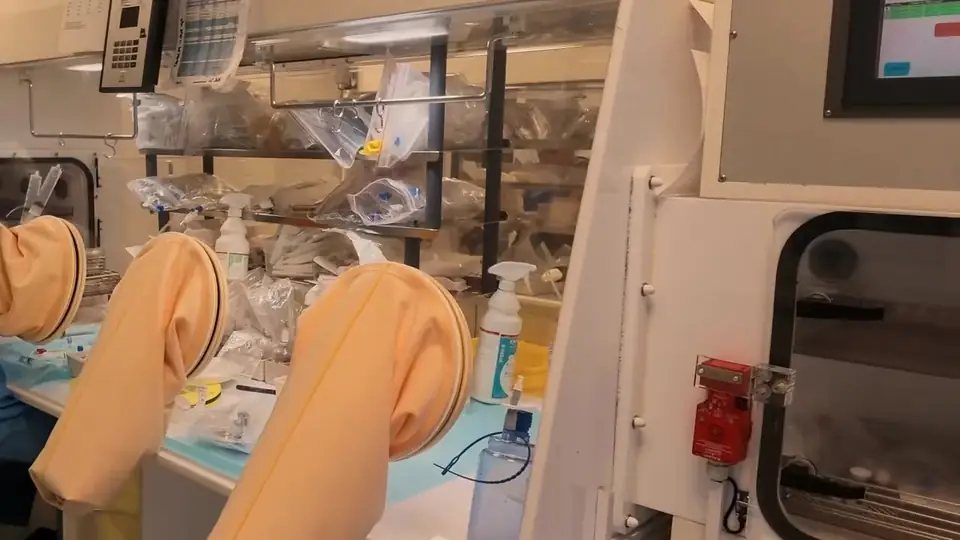
- Securing the circuit relies on three levers: analysis of activity, well-framed dose standardization and analytical control of the finished product.
- Standardization is strictly bounded: stability, share of activity covered, limited dose deviation.
- Standardized doses allow deferred batch control, without disrupting the day hospital.
- Checking patient-specific preparations requires rethinking the process and adjusting resources.
A context of strong growth in oncology
Paris Saint-Joseph Hospital has 700 beds, 56 of them dedicated to oncology. Its anticancer drug activity has grown by about 6% a year since 2010, and a new oncology unit planned by 2027 could double it.
In 2024, the unit prepared around 125 patient-specific chemotherapies a day, secured only by visual double-checking during preparation. Yet this double-checking lets through a significant share of errors, especially at high throughput. On top of this come the requirements of BPP 2023, INCa standards, SFPO recommendations, pressure on staffing and turnaround times that must remain compatible with the day hospital.
The project's objectives
- Standardize: assess the feasibility of standardized doses (dose banding) for the most prescribed molecules.
- Secure: move from visual control to automated analytical control of the finished product, with the QCRx®.
The method, in 4 steps
1. Analyze 2024 activity
Data from the Chimio® software list 26,084 preparations and 62 molecules over the year. The top ten account for most of the volume:
| Molecule | Preparations in 2024 | Share of activity |
|---|---|---|
| 5-FU infuser | 3 478 | 13 % |
| Paclitaxel | 2 759 | 11 % |
| Carboplatin | 1 958 | 8 % |
| Oxaliplatin | 1 858 | 7 % |
| Pembrolizumab | 1 445 | 6 % |
| Irinotecan | 1 308 | 5 % |
| Bevacizumab | 1 036 | 4 % |
| Gemcitabine | 934 | 4 % |
| 5-FU bolus | 861 | 3 % |
| Etoposide | 810 | 3 % |
2. Set eligibility criteria
A molecule is standardized only if it meets three conditions:
- preparation stability of more than 14 days;
- no more than 6 standardized doses covering at least 60% of prescriptions for the molecule;
- a difference between the prescribed dose and the standardized dose of 5% or less.
Five molecules meet these criteria:
| Molecule | Standardized doses | Preparations that can be standardized |
|---|---|---|
| 5-FU infuser | 6 | 88 % |
| Paclitaxel | 6 | 77 % |
| Oxaliplatin | 5 | 89 % |
| Irinotecan | 6 | 60 % |
| Pembrolizumab | 2 | 100 % |
Based on real data, this analysis also serves to present the project to the medical committee (CME), management or the regional health agency (ARS).
3. Rethink the 5-FU infusers
5-FU infusers alone account for 13% of activity. Six standardized doses were selected:
- Mother bags1 L mother bags of 5-FU are prepared from the vials.
- FillingThe infusers are filled at the standardized doses with an Infumix® system (Aseptimmed).
- Check before releaseThe mother bag is sampled and analyzed with the QCRx® before the batch is released.
This circuit allows deferred control of large volumes, while respecting the day hospital's turnaround times.
4. Build the calibration ranges
The QCRx® ranges were built in order of priority: variable-dose cytotoxics, variable-dose antibodies, then fixed-dose antibodies. Each IV bag is then verified in under 70 seconds: molecule, concentration and solvent.
The results: a largely controlled circuit
- 34%Standardized doses, all analytically controlled
- 52%Patient-specific preparations, gradually brought into just-in-time control
- 14%Not controlled: out of scope or being integrated
In total, 86% of production is analytically controlled. This result is specific to the organization of Paris Saint-Joseph Hospital. It meets the BPP 2023 requirement to broaden controls and systematically document release.
The impact on the organization
Standardization makes deferred control possible for a large part of production, without disrupting flows. Checking patient-specific preparations, on the other hand, requires rethinking the process (sampling, transport, analysis, pharmaceutical validation before release) and adjusting human resources. The SFPO also points out that preparing injectable anticancer drugs is a high-risk activity, which justifies adapting working time, staffing, ergonomics and organization.
The proposed roll-out has three stages:
- Large volumes firstDeferred control of high-volume standardized preparations: 5-FU infusers, platinum salts, taxanes.
- Then critical patient-specific preparationsExtension to the highest-risk patient-specific preparations, adjusting schedules and staffing.
- Document everythingThe approach is written into the quality system, with reference to ANSM and INCa requirements.
Analysis of activity, framed standardization, control of the finished product: the three levers reinforce one another.
Frequently asked questions
What is dose banding?+
What criteria for standardizing a molecule?+
Can patient-specific preparations be checked?+
- 2024 activity data from the anticancer drug preparation unit at Paris Saint-Joseph Hospital (Chimio® software)
- ANSM, Good Preparation Practices, 2023 edition (decision of 21 July 2023)
- SFPO, 2019 recommendations on the preparation of injectable anticancer drugs (no. 17 and no. 41)
- French National Cancer Institute (INCa), standards on securing the injectable anticancer drug circuit