
Home/Challenges and compliance

Why check the finished product? Because behind every IV bag, there is a patient.

You can follow a protocol perfectly and still obtain a non-compliant product. Only analysis of the finished product reveals it.
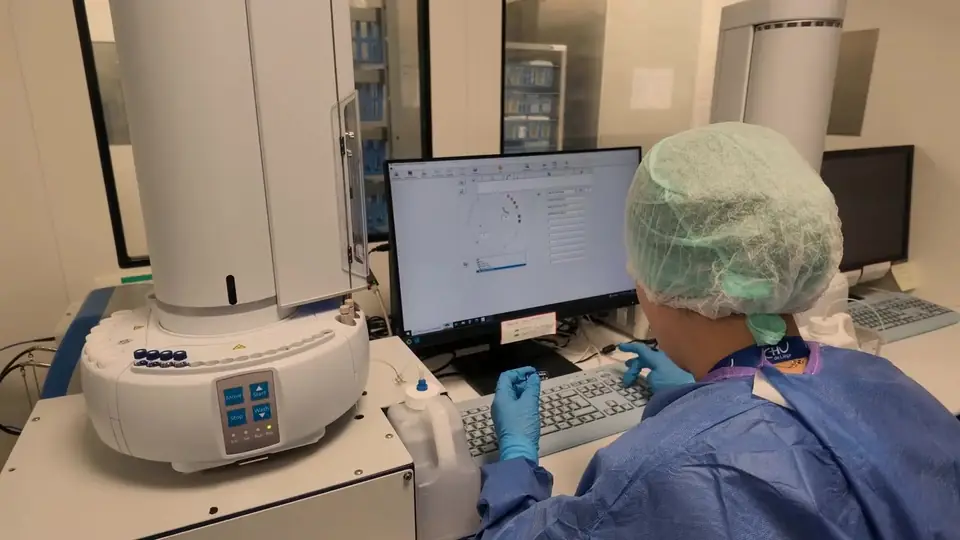
An operator starts an analysis on the QCRx® in a hospital pharmacy
40 %of preparations deviated by more than 5% from the target dose, with or without visual double-checking (simulation, HUG Geneva)
The challenge

Every preparation involves patient safety. And daily life in hospital pharmacies leaves little room for error.

Preparations per dayteam capacityPeak activityMonTueWedThuFri
On the ground

A workload that never lets up

Peaks in activity, staff turnover, often understaffed teams: the pressure is constant, and vigilance wears down over the hours.

From medical go-ahead to patient< 1 hmedical go-aheadpatientThis week's stockGemcitabineAvailableCisplatinRestockingPaclitaxelOut of stock
Flow

Ever-tighter deadlines

Uncertain supplies, just-in-time production, a patient waiting after the medical go-ahead: every minute counts, and so does every IV bag.

Several barriers, and yet…ErrorDouble-checkingVideo controlVigilance
Risk

A persistent risk of error

Fatigue, urgency, imperfect communication: even with double-checking or in-process control, all it takes is for the gaps to line up for an error to get through.

Several publications show that double-checking does not eliminate all errors, and that workload and fatigue increase the risk. See the sources

Visual double-checking

Two pairs of eyes are not enough. Studies confirm it.

3 errors out of 7went unnoticed by visual double-checking, simulation at Geneva University Hospitals
Double-checkingvisual
● error detected● error not detected

At Geneva University Hospitals, eleven operators prepared syringes under real working conditions, using marker products instead of cytotoxics. Visual double-checking detected only 4 of the 7 dose errors made. 40% of preparations deviated by more than 5% from the target dose, and double-checking made no difference.

That is 57% of dose errors spotted. Only weighing detected them all, without making doses any more accurate (Carrez et al., J Oncol Pharm Pract, 2017).

See the sources →
Deviations measured in manual preparationNine published measurements, from 0.03% to 7.74% depending on the threshold and method used+

Several teams have measured these deviations, either by weighing each step during preparation or by analyzing the finished IV bag. Depending on the threshold used, up to 7.7% of preparations show a dose deviation. Visual double-checking does not correct them: in the Geneva study, it did not improve dose accuracy.

What was measuredRatePreparationsMeasured byStudy
Wrong drug scanned0,03 %15 843Barcode, during preparationReece et al., 2016
Molecule not confirmed by analysis0,35 %5 742UV-Raman, finished IV bagNardella et al., 2016
Deviation of more than 4% when weighing the syringe5,03 %15 843Weighing, during preparationReece et al., 2016
Dose deviation of more than 10%2,25 %759 060Weighing, during preparationTerkola et al., 2017
Dose deviation of more than 15%7,74 %4 458HPLC, finished IV bagDelmas et al., 2009
Dose deviation of more than 15%1,52 %5 742UV-Raman, finished IV bagNardella et al., 2016
Dose deviation of more than 15%0,20 %69 663FIA and HPLC, finished IV bagDelis, Vigneron et al., 2015
Dose deviation of more than 20%0,7 %7 382HPLC, finished IV bagCastagne et al., 2011
Dose deviation of more than 20%0,71 %759 060Weighing, during preparationTerkola et al., 2017

Summary presented at GERPAC 2026 (Merienne and Carrez), checked against the original publications where accessible. Weighing studies measure deviations during preparation, before correction; analytical studies measure the finished IV bag. See the sources →

The alternatives

Solutions exist. But each one involves a compromise.

Chromatography · 1 sample25 min012 min25 min
Conventional analytical control · HPLC

Accurate, but slow and demanding

  • A very accurate analytical reference
  • One method per molecule, late results
  • Dedicated laboratory and qualified operators
In-process weighing + vial scanscannedused!Quali?48,6 gQuantithe weight is right, but nothing proves it is the right molecule
In-process gravimetric control

Accurate on dose, indirect on molecule

  • Checks the quantity, weighing after weighing
  • Molecule verified only by scanning the vial
  • Even with a scan, the vial can still be mixed up
Contents?RECcamera 2 · isolatorhours of recordings to review
In-process video control

Traceable, but blind to the finished product

  • Every action traced
  • Does not check the contents of the IV bag
  • Hours of recordings to review
Supervision required!!!!!a programming error repeats with every IV bag
Robotic automation

Automated, but under supervision

  • Reproducible actions
  • Constant supervision
  • A programming error repeats

In practice, none of these approaches on its own removes the risk of error on the finished product.


And in your hospital pharmacy?

Ask for a personalized assessment: based on these studies, we estimate with you the errors your controls may let through.

Book a demo
Dose banding or compounding

“We only do compounding.” That is precisely where analytical control matters most.

Each compounded dose is unique and each calculation is individualized: the risk of concentration error is higher. The QCRx® suits both approaches.

The comparison in 8 criteriaDose banding and pure compounding, side by side+
CriterionDose bandingPure compounding
PrincipleDoses standardized in bands (±5 to 10% of the theoretical dose)Dose personalized for each patient, calculated on body surface area
PreparationCan be prepared in advance, in batchesPrepared on demand, for immediate use
Risk of molecule errorPresentPresent
Risk of concentration errorPresent, but limited by fixed dosesHigher: each dose is unique, each calculation is individualized
Routine effectYes, the same doses recurNo, variability is constant
BPP 2023Controls defined by risk analysis, release by a pharmacistControls defined by risk analysis, release by a pharmacist
SFPO, recommendation no. 17A traced check for every preparationA traced check for every preparation
QCRx® suitableYesYes
Read the full article →

BPP 2023 compliance

When traceability becomes automatic. Compliance becomes a by-product of the check.

Your regulations

Canada: NAPRA Model Standards

The NAPRA Model Standards for hazardous sterile preparations require compounding personnel to verify each stage and the final preparation. The QCRx® helps you meet this requirement by analysing the finished preparation itself: drug, dose and diluent. Read the NAPRA standards

BPP 2023, chapter 4: real traceability

Each batch must have a complete record making it possible to reconstruct all operations. For controls, it contains:

  • The dated and signed results of the controls performed
  • The conclusions of the physico-chemical controls
  • The identification of operators
  • The record of any anomalies and incidents
  • The release decision, with the pharmacist's date, name and signature

Retention: at least 1 year after the batch expiry date, or 10 years if the data are used for the traceability of the register.

Key point · SFPO, recommendation no. 41
“Release testing should rely as much as possible on new gravimetric, analytical or digital technologies.”

Chapter 6 and SFPO recommendations

A preparation is released only once its quality has been judged satisfactory, by decision of a pharmacist, following a strategy based on risk analysis (points 6.2, 6.69 and 6.70). The SFPO goes further for oncology pharmacy:

  • A traced check for every preparation, aiming to replace visual double-checking with analytical, gravimetric or digital methods (no. 17)
  • Release testing under pharmaceutical responsibility (no. 19)
  • Annual qualification of equipment, ideally by a company independent of the supplier (no. 4)

The QCRx® is an analytical control tool, not document management software. It generates control data that meet the requirements; integrating them into your overall quality system remains your responsibility.

Sources and further information+
  • A systematic review found insufficient evidence that double-checking reduces administration errors compared with a single check (Koyama et al., BMJ Qual Saf, 2020).
  • Geneva University Hospitals (Carrez et al., 2017): in a simulation under real working conditions (marker products, 438 syringes), visual double-checking detected only 4 of 7 dose errors and did not improve dose accuracy.
  • In-process video systems improve traceability, but do not measure the final concentration of the preparation.
  • Several studies link occupational fatigue to an increase in medication errors; a meta-analysis estimates that nearly one pharmacist in two is affected by burnout (48%, Teoh et al., Value in Health, 2022).
  • HPLC offers high accuracy but requires a dedicated laboratory, qualified operators and one method per molecule. Method development is long and tedious (Bazin et al., Int J Pharm, 2015).
  • Even robotic automation can amplify an error if programming or supervision fails (UCSF, San Francisco, 2013: the pharmacy robot faithfully prepared 38 and a half tablets instead of one, from a wrongly entered prescription).
  • SFPO recommendations: patient waiting time of less than one hour after medical validation (no. 12), preparation sessions of no more than 2 hours at a stretch (no. 10).
  • ANSM. Good Preparation Practices. Decision of 21 July 2023 (in French).
  • SFPO. Recommendations: adaptation of resources related to oncology pharmacy, 2nd edition. July 2019.
  • Merienne and Carrez. “Sitting of the GERPAC court: the trial of analytical control”. 29th GERPAC European congress, Hyères, 2026. Summary of the studies below.
  • Delmas A. et al. Quantitative and qualitative control of cytotoxic preparations by HPLC-UV in a centralized parenteral preparations unit. J Pharm Biomed Anal. 2009;49(5):1213-1220.
  • Nardella F. et al. A UV-Raman spectrometry method for quality control of anticancer preparations: results after 18 months of implementation in hospital pharmacy. Int J Pharm. 2016;499(1):343-350.
  • Delis B., Vigneron J. et al. Contrôle analytique des préparations cytotoxiques : bilan de 7 ans d'activité et perspectives. Pharm Hosp Clin. 2015;50(2):233-242.
  • Castagne V. et al. Cytotoxics compounded sterile preparation control by HPLC during a 16-month assessment in a French university hospital. J Oncol Pharm Pract. 2011;17(3):191-196.
  • Reece K.M. et al. Implementation and evaluation of a gravimetric i.v. workflow software system in an oncology ambulatory care pharmacy. Am J Health-Syst Pharm. 2016;73(3):165-173.
  • Terkola R. et al. Evaluation of real-time data obtained from gravimetric preparation of antineoplastic agents shows medication errors with possible critical therapeutic impact. J Clin Pharm Ther. 2017;42(4):446-453.
  • Carrez L. et al. Reliability of chemotherapy preparation processes: evaluating independent double-checking and computer-assisted gravimetric control. J Oncol Pharm Pract. 2017;23(2):83-92.
  • Koyama A.K. et al. Effectiveness of double checking to reduce medication administration errors: a systematic review. BMJ Qual Saf. 2020;29(7):595-603.
  • Bazin C. et al. Comparative analysis of methods for real-time analytical control of chemotherapies preparations. Int J Pharm. 2015;494:329-336.
  • Cataldi A. et al. Alertness of in-process controls: feedback on two production errors. CHI Poissy-Saint-Germain-en-Laye, GERPAC 2022.
  • Viault M. et al. Feedback: is it useful to watch all DrugCam® videos before delivery? CH de Niort, GERPAC 2022.
  • Cho H.N. et al. Implementation and evaluation of APOTECAchemo in a community cancer center: a comparative study of robotic versus manual antineoplastic preparation. J Pharm Technol. 2024;40(6):269-276.

Ready to secure your releases?

30 minutes with an expert: an assessment of your unit, then a machine demonstration.